Tuesday, March 24, 2015

Unit 3 Book Analysis

Adventures of Huckleberry Finn

"But I reckon I got to light out for the Territory ahead of the rest, because Aunt Sally she’s going to adopt me and sivilize me and I can’t stand it. I been there before.”
Adventures of Huckleberry Finn, final lines

After the success of his children’s novel Adventures of Tom Sawyer (1876), Mark Twain was soon at work on a sequel. But the novel starting taking on a much more serious tone than he anticipated, and Twain set it aside for a number of years. In the 1880’s, the initial optimism of Reconstruction began to fade and the South entered a time of social unrest. It might have been the increasing weight of racial oppression, with the Jim Crow laws looming just five years away, that motivated Twain to finish and publish Adventures of Huckleberry Finn in 1885. In it, the titular Huck is living in pre-war Mississippi, with a mean drunk for a father and under the care of the Widow Douglas, who is determined to whip him into a civilized, church-going young man. Finding the atmosphere oppressive, Huck soon begins his journey aboard a raft with a runaway slave named Jim. Along the way, he becomes more resolved that he’s better off not becoming “sivilized” as society defined it at the time.

The noble thing about Huckleberry Finn is how the novel allows itself to settle completely in the mind of a young man. Twain has a lot of institutions to address—Southern society, religion, intellectualism, and especially racism and slavery. But he writes in vernacular English and speaks through the uneducated Huck, with moral lessons either understated or not articulated at all by its narrator. It is in this voice that Twain accomplishes his best of satire, not to mention moments of honesty. Twain allows Huck to wrestle with the cognitive dissonance that results when ideas and beliefs begin to contradict one another.

At first Huck lives under many of the same assumptions and traditions as the rest of the white folks around him. Jim quickly becomes a kind of father figure for Huck, but despite helping him escape, Huck is slow break the notion that he should treat Jim as anything but inferior. Early in their journey, Huck apologizes to Jim after teasing him, and actually feels guilty about feeling guilty—that he should be humbled by a black man. Huck meets a series of colorful characters along his journey, with most of them—like the band of robbers, the feuding and ill-fated Grangerford and Shepherdson families, and the two con-men masquerading as royalty—serving to convince Huck of how hypocritical his society actually is.

That kind of cognitive dissonance only increases, right until the moment that Jim is sold to another family. Huck believes that freeing Jim will lead to Huck’s own damnation, but resolves to help Jim anyway, declaring "All right, then, I'll go to hell!”

The novel resolves tidily—Jim is freed once again, and the well-meaning Sally Phelps offers to adopt Huck. But Huck, as he says in the novel’s closing lines, has “been there before.” Huck is fond of the Phelpses and they only want what they perceive as best for him, the pillars of society in the South: religion, etiquette, education, and morality. But as Huck has come to see it, piety and hygiene aren’t worth much and, though he might not be able to articulate as much, he can do a better job educating himself that society has done thus far. Huck decides to head West, where civilization hasn’t had a chance to arrive yet.

Diversity is about inclusion—adopting or at least acknowledging ideas and cultures different from one’s own. But in Huck’s case it’s equally about rejection—of his old life, of “decent society.” Huck’s quest has prepared him discern for himself, to take the best of every world he encounters, accepting truth where he finds it, and rejecting the worst—the end goal for children in their efforts to make diversify, challenge their own beliefs, and make new discoveries.

Tuesday, March 17, 2015

Week 9

Diversity


 “One of the reasons I made [George Washington] is because movies talk down to kids, put them as a cute little kid with a box of cereal and a witty joke… You watch movies like Kindergarten Cop and it's like, 'Oh, a kid said something about sex. Isn't that funny?' It's just annoying and it makes me sad for their parents.”
 Gordon Green
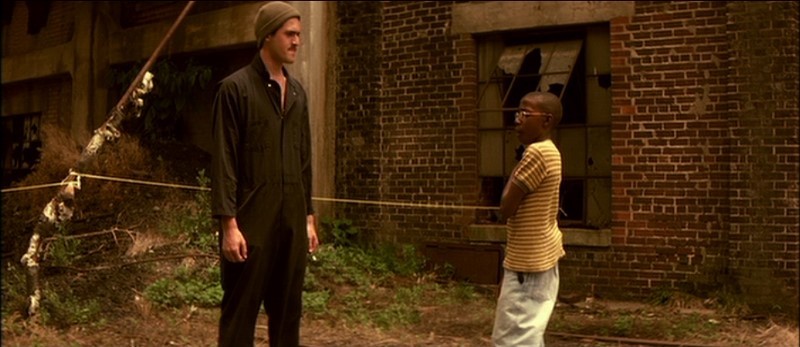
Gordon Green’s first film, George Washington (2000) is a story of a group of young friends during a hot North Carolina summer. After an unexpected tragedy, the kids are forced to decide how they will cope and find their individual stories of redemption.

When we talk about portrayals of diversity in the media, it’s probably something less useful studied through individual examples versus in the media collectively—recognizing trends across years, within genres, or among target audiences. It’s just not realistic to expect a single work to be completely representative of every combination of race, gender, sexual orientation, and socioeconomic status. Still, it’s worth noting when a piece of media makes a conscious attempt to avoid being completely homogenous.

In George Washington, Green is concerned with giving every character a voice. It’s more than just a story about a racially integrated town. It’s about honest and intimate portrayals of how we cope with tragedy and loss. It isn’t a token thing. The film has an almost documentary-feel and a dreamlike, Terrence Malick-esque pace that allows its characters to play out their stories and reach their conclusions on their own time. When diverse characters are allowed to be more than tools, but real people, these stories evolve as much into a study how much people have in common as much as what our differences are.

Exposure to new perspectives is essential during a kid’s formative years, because kids often have such a limited perspective based on where they are born and raised. But children’s media can be  particularly weak  when it comes to these types of portrayals, with minority characters rarely featured, and even less in major roles. There are real problems that come with being raised believing that there is only one way to live. When attempts are made to be more diverse, it can allow for a sense of inclusion for those not normally represented, and offer a new or unfamiliar perspective the audience may not have considered before. It allows children and adults alike to grow as people, gain new insight, and have more charity.

And, in honor of my favorite show that returned today:

Tuesday, February 3, 2015

Unit One Book Report

Stargirl by Jerry Spinelli

"She laughed when there was no joke. She danced when there was no music. She had no friends, yet she was the friendliest person in school....
"We did not know what to make of her. In our minds we tried to pin her to a corkboard like a butterfly, but the pin merely went through and away she flew" (Stargirl, 15).
 

Stargirl is a 2002 young adult novel by Jerry Spinelli, detailing a young man’s recollections of a year in a small-town Arizona high school, and the events set into motion by the arrival of an eccentric young woman. Her name is Susan Caraway, but she is known simply as “Stargirl.” In a homogenous school community, when Stargirl appears in her strange outfits and toting a pet rat, ukulele, and sunflower bag everywhere she goes, there is immediate stir. Leo, the narrator, finds himself smitten, and must decide whether to act on his feelings under the pressure of his classmates’ opinions. Under even greater pressure, Stargirl herself must decide whether she will conform to the other kids’ standards, or maintain her individuality. High School is a social microcosm, an idea reflected in a lot of great children’s literature, and in Stargirl, Spinelli treats that environment as a testing ground for moral and ethical lessons.
“Mica Area High School–MAHS–was not exactly a hotbed of nonconformity.  There were individual variants here and there, of course, but within pretty narrow limits we all wore the same clothes, talked the same way, ate the same food, listened to the same music.  Even our dorks and nerds had a MAHS stamp on them.  If we happened to somehow distinguish ourselves, we quickly snapped back into place, like rubber bands” (10).
Stargirl has been homeschooled all her life, and arrives at MAHS blissfuly unaware of the expectations placed on students to conform to certain social stereotypes. She is mysterious, strange, and completely outward-focused. She has personal files on everyone in town, tracking likes and birthdays. She sings happy birthday to students every day in the cafeteria. She leaves kind anonymous notes and gifts. Over the course of the year, she goes from unknown alien, to the most popular kid in school, and back again to social pariah in a backlash following a game in which she cheered for both schools’ teams. In the midst of this, she and Leo begin a tentative relationship.

Stargirl creates a constant tension between the characters’ longing for acceptance, and the desire to remain truthful to their individuality. The “just be yourself!” message so common throughout young adult literature is often quick to count the benefits of that kind of attitude, but slow to count the real-world cost. Stargirl’s eccentricity allows her to pursue many passions, make friends young and old, and explore her creativity. But as her character is revealed there is a tangible sense of loneliness surrounding her. That same loneliness may actually be a benefit, providing Stargirl with time for the quiet meditation and growth that define her. But loneliness can become disheartening.
“I had never realized how much I needed the attention of others to confirm my own presence” (126).
The choice is not an easy one, and the tension in Leo and Stargirl’s relationship builds until she drapes a sheet in front of the school with large letters reading “STARGIRL LOVES LEO” and Leo caves under the pressure. In an effort to make him happy, and in part to regain some of the friends she has lost, for a brief time Stargirl becomes simply “Susan,” blending into the crowd with everyone else. But she soon snaps back. Her and Leo drift apart. She makes a final, memorable appearance at the prom, and then disappears forever. Leo writes from years later, when the story of Stargirl has become legend, and former students that shunned her now remember her fondly. Leo concludes with the hope that they might someday meet again.

In many ways High School is unique. It’s a time when the need for acceptance his more overpowering than perhaps any other point in life. But in many ways it’s completely representative of adult life: people have essentially the same insecurities, the same predisposition toward self-centeredness. There's a reason similar books have captured the imagination of children; "Stargirl Societies" now exist in schools across the country, inspired by Spinelli's character. Media and literature like Stargirl develop resonant themes of individualism, kindness, open-mindedness, and persistence that kids can take from the stage of adolescence to apply throughout the rest of their lives.
"Stargirl Sketch" by Hannah, 17 years old.

Unit One Film Analysis

 Time Bandits
EVIL: God isn't interested in technology. He cares nothing for the microchip or the silicon revolution. Look how he spends his time, forty-three species of parrots! Nipples for men!
ROBERT: Slugs.
EVIL: Slugs! HE created slugs! They can't hear. They can't speak. They can't operate machinery. Are we not in the hands of a lunatic?


Time Bandits (1981) is the first installment of Terry Gilliams’ loose and named-in-hindsight “Trilogy of Imagination,” followed by Brazil (1985) and The Adventures of Baron Munchausen (1988). It’s the story of young Kevin, who joins a larcenous band of dwarves on their journey though time to steal history’s most valuable objects. It’s marked by the kind of surreal, often dark imagery and absurd humor that Gilliam began developing in his Python days, which has since become his trademark. It’s episodic, following the band as they are pursued by “The Supreme Being,” leaping from historical time periods, to fantasy settings, toward an ultimate showdown with Evil. As an adventure, it’s wondrously bizarre tale who’s chapters might not exactly sum up to a cohesive whole—which might make it the perfect coupling of form and content for film about childhood dreams. It’s a fantasy about the power of imagination unleashed as a child’s means of coping with a perplexing and superficial adult world, and his disillusionment to hero worship.

IIn a vaguely dystopian suburban setting, Kevin observes his greedy parents obsessively compare their latest household appliances to those of the neighbors. Throughout the film, technology is vaguely associated with evil. After they order him to bed, Kevin sees a horsed knight burst through his closet door and ride away. Some time later, we see a knight appear among dozens of Kevin’s drawings on the wall. Gilliam’s filmmaking is marked by a certain refusal to intellectualize, and we’re never sure if Kevin’s adventures are real or imagined.

A much later sequence is representative of the adventure as whole. Kevin and his friends land aboard an ogre’s ship, fix his bad back while he wife makes fondue, and toss them overboard. The Ogre’s cough then creates a wind that blows the ship across the water, which turns out to be sitting on top of a giant’s head. They escape the giant by finding a sleeping potion on board, tearing a hole through the ship’s floor, and injecting it into the giant’s head using fireplace bellows. This entire sequence takes place in less than five minutes.

What unfolds is plotted as if by child’s logic, told from a child’s perspective, in a dreamlike haze. Much of the dialogue seems almost like it was written stream-of-consciousness. The cameras remain low for the entire film, a kid’s-eye-view just three or four feet from the ground. The character Evil is a child’s-cartoon version of the Devil. When great moral questions are presented, they’re answered offhandedly by authority figures who seem to be barely paying attention to the question. In the end, the Supreme Being—a suit-wearing, schoolmaster-type God—appears out of nowhere and quickly defeats Evil. He then reveals that the events, including lives lost, have been a part of his plan all along. Kevin asks him, “But why does there have to be evil?” Distracted, he replies “I think it has something to do with free will. “

What begins seemingly as simple escapism soon evolves into something more, as one after another of Kevin’s heroes begin to disappoint him. Robin Hood is an upper-class, narcissist twit; Napoleon comes up short, and Agamemnon declines to teach Kevin sword fighting in favor of “much more useful” magic tricks. In Kevin’s world, he has to learn that adults don’t have the answers. Kevin returns home in the midst of a house fire. His parents are scrambling to remove their most valued appliances. From outside, the mother yells,“I’m going in for the toaster!” After ignoring Kevin’s warning to not touch a bit of evil goo, they spontaneously explode, leaving Kevin alone with two billowing pillars of smoke. The film ends on that traumatic note. Though disturbing, Kevin has learned through his adventure of taking care of himself.

Time Bandits is part adventure fantasy, part social satire, part childhood existential nightmare. It was appropriately tag-lined “it’s all the dreams you’ve ever had, and not just the good ones.”  It’s certainly a child’s film—though whether or not it’s actually for kids is definitely up for debate—and the ease with which Gilliam accesses the childlike mindset it quite brilliant. Ideas are free-flowing, and sometimes a child’s solution truly is the best. Though often fantasy, adventure stories can help children learn about and cope with difficult realities.

“If I’d actually learned any of the lessons, I wouldn’t be making films anymore. I try not to learn. I spend most of my life unlearning.”
Terry Gilliam

Tuesday, January 20, 2015

Week Two

 Morality

The Jungle Book (1967), Directed by Wolfgang Reitherman
"I have long felt that the way to keep children out of trouble is to keep them interested in things. Lecturing to children is no answer to delinquency. Preaching won't keep youngsters out of trouble, but keeping their minds occupied will."
- Walt Disney, "Deeds Rather than Words"

In Walt Disney's The Jungle Book (1967), based on stories by Rudyard Kipling, a young boy name Mowgli is raised and shaped within a world full of danger around every turn. His story is about his reluctance to leave such a world and enter what we might call normal, secure civilization. This was the last film Walt himself produced, though he wouldn't live through its completion, and his proclaimed "entertain first, preach second" philosophy didn't stop him from injecting this film (and many others) with definite moral undertones. Children's media has always been seen as an opportunity to present moral lessons, and many of the most memorable media experiences from my childhood are shining examples of that.

The Giving Tree (1964), Written and illustrated by Shel Silverstein

In the same essay quoted above, Walt Disney talks about the importance of exposing children to portrayals of both light and darkness in media. The same must happen to the characters. In The Jungle Book, Mowgli is confronted by danger and temptation on every side. In order to make choices and develop, there is a necessary exposure to evil. Or, to put it more scripturally, and in a father's words to his young son:
"For it must needs be, that there is an opposition in all things. If not so, my firstborn in the wilderness, righteousness could not be brought to pass, neither wickedness, neither holiness nor misery, neither good nor bad..."
- 2 Nephi 2:11 

Portrayals of morality can be subtle or overt. Walt Disney's comments serve as an interesting question: what responsibility to we have to include good morals in our stories for children? And to what extent do we expect the kids to "get it," or just be entertained? One of my favorite films growing up also happens to be one of the most barefaced, Old-Testament-punishment-style morality tales I know of for kids, but I'm still not sure if I came away from it having learned anything, or just with a craving for chocolate:


Willy Wonka and the Chocolate Factory (1971), directed by Mel Stuart.

Like Charlie's adventure through the factory, Mowgli's reluctant journey for civilized society is very episodic in nature. As they run the proverbial gauntlet they meets a number of distinctive characters and situations that test or challenge him in some way. In the case of The Jungle Book, the climax of the film is Mowgli's showdown with Shere Khan, but the film doesn't have just one solitary villain, and they all have something to teach him in one way or another. If you were so inclined, you might even begin to break down the colored cast of characters Mowgli encounters into, say, embodiments of the seven deadly sins:

Wrath: You have Shere Khan the tiger, who hates man and wants to destroy him at any cost.
Gluttony: Kaa, the cobra, who is driven only by appetite.
Envy: King Louie the ape, who aspires to be like man and have everything he does.
Sloth: Baloo the bear, the friendliest of the bunch, living by the philosophy that what you need in live will just "come to you." Though not a villain by any means, he might be the greatest threat of all to Mowgli, because he represents Mowgli's own desire to shirk responsibility and just stay in the jungle.

If we wanted to force the comparison further we could probably identify an embodiment of pride (like Colonol Hathi the elephant), and perhaps even lust. But the more important point is that each encounter gives Mowgli a chance, doctrinally speaking, to exercise his agency; to transgress and pay the consequences, or to "choose the right" and progress on his quest. As in all morality tales, characters' choices bring about either good or bad consequences. Mowgli's eventual shows of courage and resourcefulness lead him safely to his destination, while the wrath of Khan (see what I did there?) is is downfall--there's room for a William Blake joke in there somewhere, about Tygers burning bright, but I'll wrap this up.

Portrayals of morality in children's media can range from overt, to subtle, to practically non-existent (like in Tex Avery's Red Hot Riding Hood that we watched in class). Questions about what responsibility, if any, we expect from children with regards to the media they see, and what responsibility is expected of the producer's of that media, are ones that I hope to explore further in this class. But teaching and entertainment in children's media need not be mutually exclusive. We only need to decide which to prioritize.

Monday, January 12, 2015

Week One

Intro to Children's Media

The White Balloon (Panahi, 1995); E.T. (Spielberg, 1982); Boyhood (2014, Linklater)

I’ve often heard it repeated that everything we need to know, we learned in kindergarten. In my case I’ve found that to be pretty accurate, and the rest of my life has been spent in the (often failed) application of those lessons. For the sake of simplicity, let's say that children's media can be defined by one of four camps: media for children, media about children, media by children, and all the media children are exposed to whether they’re meant to or not. Son of Rambow (2007) manages to be and explore a bit of all these at once.


Still from Son of Rambow (2007)


Trying to define children’s media in the first place is difficult, but I think Son of Rambow is at least indicative of what the best children’s media should attempt to do. For children, it can serve as a jumping off point for adventure and discovery while also teaching some of those essential formative lessons—to have passion for a goal, to play well with others, to overcome challenges. And for grown-ups, it can act as a point of access for the rediscovery of things that have are often forgotten, and desperately needed. Music, films and stories are made so often with this kind of attempt in mind. Here’s one of my favorite examples:


The White Stripes, "We're Going to Be Friends" (2001)

I think what Jack White is trying to do here is important, and it's the same thing Son of Rambow accomplishes. While we shouldn’t necessarily put childhood on a pedestal, it’s even more important that these kinds of stories aren’t told from above, looking down. First of all, kids can have a pretty good idea of when they’re being force-fed some kind of lesson. And second, it’s a period of time to learn from, not scoff at. The adventures of Will and Lee Carter are told from their perspective, and treated as no less real or daunting than the challenges facing the adults in the story. The lesson is that it’s okay to be smart, creative, and even a little rebellious at times.

And like the best stories of any type, even our hero is allowed to make mistakes. Will is swept up in his power and newfound ambition as a filmmaker and is cruel to the first boy he befriended. There are real and nearly deadly consequences, and Lee Carter ends up in the hospital. There are some heavy themes at work in Son of Rambow: there’s guilt as Will struggles to reconcile his family’s faith with his passion for creation. There is unrequited love for family as Lee Carter silently craves the affection of his older brother. The biggest realization I had during the screening of the film was this: good children’s media isn’t afraid to deal with big issues and ask important questions. There’s something kind of magical and liberating for children and adults alike when we recognize that while we do our best, adults don’t have all the answers either. Doubt, fear, shame, loneliness, loss—these things affect all of us regardless of age. Children’s media is where we can find common ground and ask universal questions. There we can find meaning in the experiences that transcend age, time, or place.


Scene from The Little Fugitive (1953), Dir. by Ray Ashley

Monday, April 21, 2014

Fireside Chat Artist Statement

I had a different experience for this assignment because as much as I wanted to, I couldn't be at the actual fireside chat. There were a lot of possibilities I considered. Like all the assignments we've had this semester, there were a lot of possibilities and directions I could have taken it. In the end I decided that I wanted to talk a little about art itself and where our inspiration comes from.

My original idea was to make a kind of "rube goldberg," the same kind that I talked about in my story. I wanted to be able to design beforehand but put together as I talked to the class to use at the end. I even had a lot of it put together before going to the classroom and realizing that the layout of the class wouldn't work for what I was working on. So admittedly what I ended up presenting was kind of a last-minute job. But I did my best to present the same kind of idea--mostly that what we create draws on many different sources that have influenced us, and that we can create using scraps of other things and reform them to create something new. Overall the change in medium weakened what I was trying to say a little bit.

As to the actual creation of the mashup I made, I probably spent more hours getting it more or less the way I wanted it than I would have on my original idea. I wanted to draw from a number of different genres (hip-hop, alternative rock, classical, etc.) and use bits and pieces to share kind of a story-within-a-story during my presentation. The different clips of music worked together to form a story of loss of love and recovery. But more important than the story itself was the idea behind its creation. Since I was a little kid I have loved the process of turning something or things into something new as a way of expressing myself. This class has empowered me to be able to do that more effectively, and my fireside chat project was a means of me expressing appreciation for that process and my belief that art is a just a remix of the experiences we have had throughout our lives.

Here is the mashup (not exactly as it sounded during the performance, as some of it was improvised:


List of songs (including those used in performance):

Bittersweet Symphony--The Verve
15 Step--Radiohead
Ridin' Solo--Jason Derulo
Wake Me Up--Avicii
Under the Bridge--Red Hot Chili Peppers
Erase Me--Kid Cudi 
Bohemian Rhapsody--Queen
Tubthumping--Chubawumba
Single Ladies--Beyonce
All By Myself--Eric Carmen
My Heart Will Go On--Celine Dion
Where is My Mind--Pixies
Wonderwall--Oasis 
Hey Soul Sister--Train
Starlight--Muse
Wanna Be Startin' Something--Michael Jackson
The Darkness--I Believe in a Thing Called Love
Till I Collapse--Eminem
Can't Hold Us--Macklemore