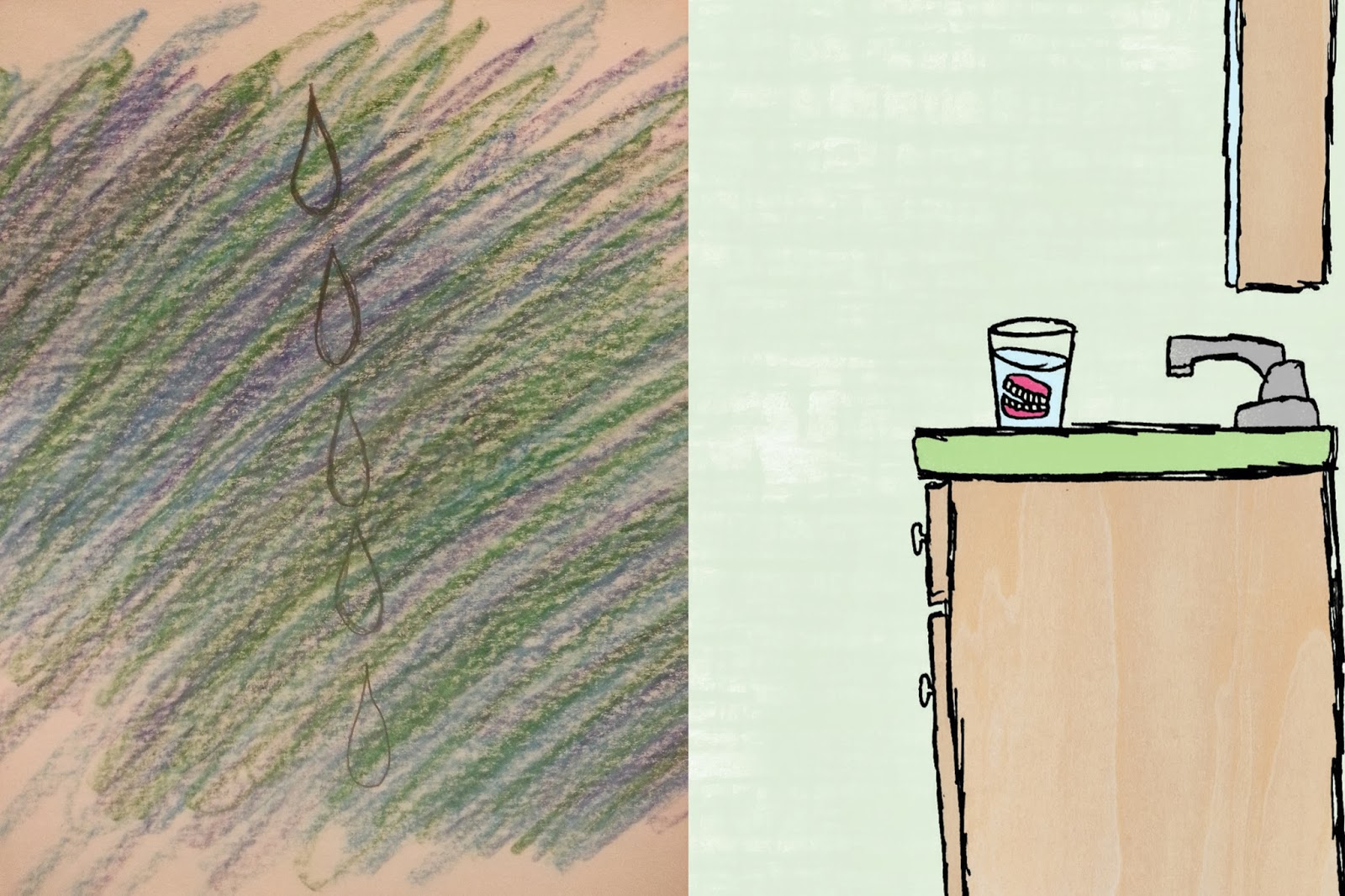
Tuesday, February 11, 2014

Artist Statement: Historical Story

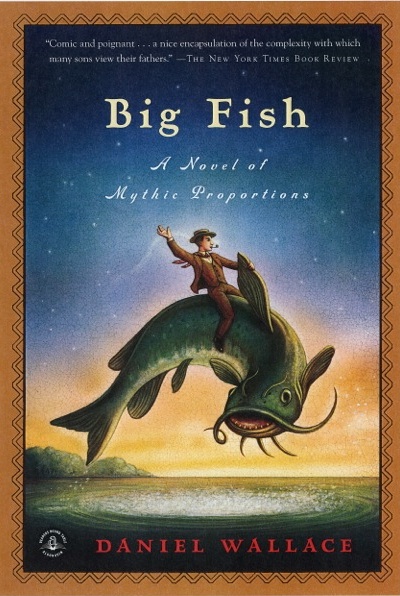
In “Big Fish: A Novel of Mythic Proportions” Daniel Wallace tells the story of a young man at his father’s deathbed, trying to discover the truth about who his father really was after a lifetime of hearing his tall tales. First frustrated and feeling like he doesn’t know his father at all, he comes to discover that the myths his father had created of his life are actually based on real experiences, and are perhaps more telling of his father’s life and character than reality could be. In “Vivian, Fort Barnewll,” Ethan Canin reflects on a picture of his mother hanging blankets in their yard. But when he actually sees the picture again, he realizes first that she was not actually hanging blankets, and looking closer reveals that the woman in the picture is actually his grandmother. Both of these stories explore history and memory and highlight some of the thoughts I’ve had over this past week in class and working on the historical story. I’ve thought about history, how we hear and remember it, and how it affects us. 

In our historical story, we try to explore some themes of love and commitment, of escapism and facing reality. It’s based—but not necessarily confined to—true experiences from the life of Danny’s great-grandfather, who worked on-set of MGM’s 1935 adaptation of Anna Karenina. His wife was having—and would continue to have—serious health an emotional problems after the birth of their first child. In the script, he comes more to terms with his situations from a diner conversation with star Greta Garbo and drawing some inspiration from the film.

In reality, that conversation never actually happened. But Danny’s grandfather did love his wife and spent his life caring for her despite the struggles. In telling the story, we pin to a specific moment in time at least part of Charles’ coming to terms with reality. It could be that when we represent fully developed character arcs, with all their epiphanies and realizations, so tidily in stories that we do a bit of injustice to what for many is the real struggle—the slow, gradual, two-steps-forward-one-step-back kind of growth that is constantly challenged and doubted throughout the course of a life. But I think this “life concentrate” still has value and is worthy of being told. We learn in “Big Fish” that there is much value to be gained from stories, whether they are embellished or condensed. Morals and lessons are tied to but not restricted by real-life experiences. But this kind of thing tends to happen whether we want it to or not. It’s always going to be impossible to tell a story and represent 100% what an event was actually like. But looking into our pasts, we will remember the things that have most meaning for us and take from them the lessons we need to shape our futures.

Wednesday, February 5, 2014

Process Piece


When making our process piece, Madi and I wanted to represent a character moving from a more chaotic, stressful place to a relaxing one. It's a simple story. A character starts indoors, hearing music and people talking, and decides to leave. He makes his way through the street to a place where he can take a break and feel peace for a few minutes.

As for the process of actually making it, though it's a simple idea, we had to record in five or six different locations to capture the different sounds—the ducks, people, music, foley, traffic, etc. The clip is under two minutes, but the actual process takes closer to ten to complete. At one point near the end, there are four audio tracks overlapped. But because the main idea of the piece was about getting in touch with nature, we tried to make the stitches transparent. Using fades and other transitions we tried to make it sound as natural and seamless as possible.

Over the last week I watched and read a lot about processes being performed. During discussions in class, I thought about a documentary I saw recently called Leviathan, which covers the fishing industry and has almost no dialogue. There’s not a story per say, but instead visual after visual as the cameras delve into the perspective of workers, the fish, or even inanimate objects. I think that in a way, by not setting out to create a strict narrative, it manages to say even more in a very poetic but unpretentious way. 

Among a lot of other videos I watched, I love the clip of Jack White making a “guitar” at the beginning of It Might Get Loud. There is something about observing someone make something they are passionate about—it’s fascinating to watch even when there isn’t much happening on screen in terms of drama. I really appreciated the discussions from this last week. We naturally appreciate something more when we are part of the process of its creation—whether as a participant or simply as a viewer. All those things came together to reinforce the same idea: that the process of creation can be art just as much as the end product. 


Tuesday, January 28, 2014

Round Robin: Artist Statement

Looking at the evolution of my own series, as an artist I can really only account for the part I had control over. It was definitely interesting to see how my idea evolved as it was worked on my five different people. It did turn into something of a narrative “exquisite corpse” with each artists’ voice coming through even though there was a surprising bit of common ground between the different stories. Most obviously, all except the last dealt explicitly with doctors and hospitals (and the last the idea might be implied). It quickly evolved into dealing with strange conditions, tension, and even terror, which had existed in my original story to an extent but I had tried to downplay with the last sentence and give it more of a humorous note (see the earlier post for my series).

As for the stories I added to the other series’ in my group, I tried at first to keep the overall tone of the “tiny stories” consistent. That worked out pretty well for the first three contributions I made, but with Hannah and Neeko’s series’, I might have taken things down a less-serious route.

But apart from tone, with each I tried I tried to pick a different attribute or set of attributes to tie it to what had already been done. After writing my own tiny story the first contribution I made was to Liz’s. I liked the idea she had of writing a poem so I decided to keep the rhyme scheme. I focused on a different element that was just a detail in the picture she made, the flowers, but gave them their own story. Both stories are about unrequited love, but in the latter, the protagonists (or rather, the victims) are the flowers being offered to another. I also gave it my best shot at doing the art work in a similar style—which didn’t exactly turn out well, so it was my last attempt at doing so.

Liz's artwork for her original story and the art that I added. Scroll to the end to read.

With Kelton’s series I was more flexible. It was the idea of a one-sided relationship that I continued.

The image for the 2nd story in Kelton's series (by Liz) and the 3rd (by me). 

With Hannah’s series I tried to pass on something of the themes of beauty and maybe a hint of self-consciousness, even though mine took more of a ridiculous tone and was more exaggerated. 

The image for the 3nd story in Hannah's series (by Liz) and the 4rd (by me). 


Finally, with Neeko’s story it was the idea of having something hidden and about to be exposed.


The images for the 4th and 5th story in Neeko's series.

I didn’t really notice until looked back on what I had written, but there is something of the same sense of humor in all five of the stories I added. It was something of myself I contributed that changed the outcome of the stories even though I was trying to keep things thematically similar. That was most interesting thing I learned from this assignment: that we can’t exactly separate the art from the artist. Unavoidably, we will always leave impressions of ourselves on our work. That’s part of what makes art so satisfying. For me it was a comforting thought that even in a culture where much or all of what we produce might get lost in a kind of giant collective experiment, some part of ourselves will always remain in the art we influence.


Click "Read More" below to read the stories I wrote for the others' series.


Monday, January 27, 2014

Round Robin

1. First Story
Jesse

"I understand that you're shocked. Regaining consciousness after the state you were in for so long is extremely rare." "I understand, Doc," Joe managed, but  his head was swimming with questions. His last memory was the sound of screeching tires. Where were his parents? Was Kelly okay? And would he be able to get a refund on those Nirvana tickets?


2. Second Story
Neeko

 Gary rubs his temples: the lights from the hospital lights are blinding.  He has a crazy thirst and reaches for the glass of water on the in table.  As he lifts the cup to his parched lips, he sees an array of blue and red lines refracting in the bottom of the glass.  He moves the cup to reveal several red and blue I.V> tubes coming from his forearm.

“Never seen that before.” Gary mumbles.  He sets the glass back down on the table and notices a digital alarm clock.  Someone has tampered with the small plastic device.  Red and blue wires jut out from the side.  Gary’s eyes grow wider and wider as he traces them back to his forearm.

“Those aren’t I.V.’s…there wires.”

The doctor comes into the room and sits at a metal chair by the bed.

“What is this doc?”

“Time.  That’s what you came here for isn’t it?”

“But what the—?”

“Every day at twelve o’clock—noon or morning—the alarm will go off. You have until it stops to live.”

A joke: it had to have been some crass sense of humor, but the iron brow of the good doctor clearly stated that it was anything but.

“And…if I—“

“—Want to continue breathing you’ll hit the snooze button before the alarm stops.  Good day sir.”

The doctor left Gary to his own befuddlement. Gary turned the alarm clock towards him, the blood-red digital numbers read 11:59.


3. Third Story
Hannah

Ray rolled his eyes and glanced in the rearview mirror. Great. He thought, now I’m really going to be late. He sighed and pulled onto the shoulder of the road as the red and blue lights continued to flash persistently behind him, all the while stressing about the meeting he was supposed to attend at twelve o’clock. Having worked the night shift, Ray was exhausted, and he had pushed the snooze button one too many times this morning. An officer jumped out of the car and hurried toward him. That’s odd, Ray thought, what’s his hurry?

“Are you Doctor Raymond Latigid?” he asked, almost out of breath.

Now Ray was worried, “Yes, is there a problem officer?”

“I was ordered to find you, sir. We need help with an illness and Chief says you’re the best doctor in town. There’s talk that we’ve got an epidemic on our hands.”

Ray could tell by the officer’s expression that this was not a joke. “Alright,” he responded grimly, “I’ll see what I can do.”


4. Fourth Story
Kelton

The hospital looked normal enough, but Ray could tell by the officer's face that there was nothing normal about what he was about to be shown. They stepped silently into the elevator. When they reached their floor, Ray was nearly blown back by the noise as the doors opened. Nurses were frantically tending to patients who were screaming in terror. "They seem to be in some sort of terrified coma, and what's worse, the condition seems to be spreading by touch," said the nearest nurse to Ray. Ray knew this was beyond any of his medical expertise, but he knew he needed to help. "What do you need me to do?" he asked...

5. Fifth Story
Liz


"I don't--
I can't--
What is--
Where is--
I need--
Help me--"
Her eyes rolled back in her head

Monday, January 20, 2014

Music Mosaic: Atlas--Battles


Our senses don’t operate in complete independence from each other. Listening to a song can evoke thoughts, images, or even smells or tastes.  Most often when I hear a piece of music for the first time, I immediately form some kind of impression or a story that returns whenever I hear it again. One of these songs was Battles’ “Atlas, ” a mostly-instrumental piece of experimental rock with some gibberish-sounding vocal-work. It’s worth a listen:


Atlas by Battles on Grooveshark

"Atlas" is an adventure. That was the impression, pure and simple. It's a fun song, but an adventurous one. It begins with a simple but catchy beat, and the first section of the song is just one instrument building on another. Before a minute passes, the chant begins like a call to adventure. To me it always seemed like an invitation to take a break from the monotony to participate in something a little more death-defying. And that’s just what it does; over the course of its seven-minute run it creates a nice journey of falls and crescendos.

And so we meet our hero. He was around long before I was consciously aware, popping in and out of existence every time I gave the song a listen, as it often happen. The eight images I put together were my best attempt to go along for the ride, to put visually what I imagined his world—and his story—must be like.


It begins (1) with a simple portrait of the hero himself, at home, but with a burning desire for adventure. For a moment he is caught between two worlds, before yielding to the call and setting off on his quest. He reaches the point of no return (2, about the point 1:15 in the song), looking ahead into the unknown and realizing how far he needs to go to get what he wants.


So he jumps right in. I depicted this phase of his adventure as a sort of Hercules-like labors (3 & 4) he needs to undergo to prepare himself for the final challenge. This is the longest stretch of the adventure. 


He struggles against seeming impossibility but doesn’t cave under the weight, until at last he faces the final showdown with what it is he fears (5, about point 5:30).


He is beaten and almost defeated, but as he falls he discovers faith and strength he hadn’t been aware of (6). 


In doing so, he is transformed and conquers his fears and obstacles (7). At last, he makes his journey home (8), having gained his prize and becoming changed in the process.


Its simple jungle-beat almost never takes a break, keeping the song constantly bouncing forward. The journey is there. To be honest, I let myself get a little carried away with the theme. This kind of adventure was always much more lighthearted in my mind than it ended up on paper. By the end, it had evolved into something a little more epic-looking than I really wanted. But with art as well as these kinds of adventures, we don’t always get what we expect but usually learn even more about ourselves in the process.